Michael Kaung
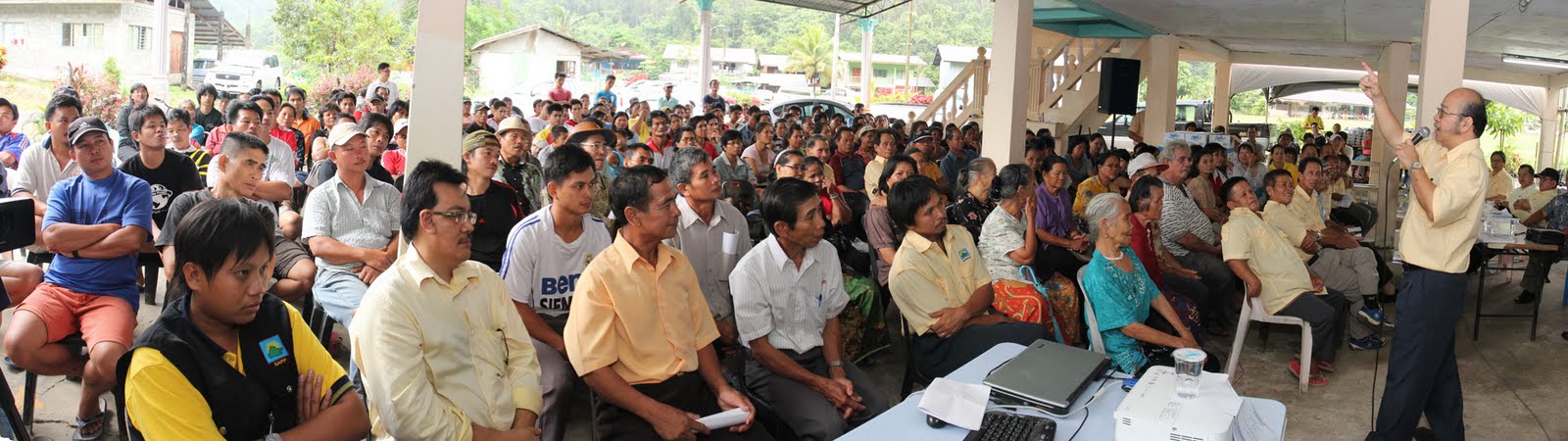
Suhakam hears why the villagers don’t want a dam in their midst.
PENAMPANG: The villagers of Tambatuon are anxious to avoid the heartbreak that the people of Bakun suffer, according to testimony before Suhakam commissioners who are conducting a study on Native Customary Land Rights (NCR) issues.
Jahim Singkui, who heads the Tambatuon Villagers’ Action Committee, told the commissioners today that the government had ignored pleas against its plan to build a RM450 million dam in the village, which is in the Kota Belud district.
The project would submerge ancestral lands, he said.
Jahim, the son of a former village head of Kampung Tambatuon, said he went to Sarawak to talk to the people forced out of their lands to make way for the Bakun Dam.
All he heard from them were tales of disappointment, he said. “They have been short changed by the government.”
He said the Tambatuon villagers were not interested in any offer of compensation because they did not want to end up heartbroken and bitter like the Bakun folk.
Furthermore, he added, the government had disappointed them before. Some years ago, he explained, the villagers asked for assistance to implement an irrigation scheme so that they could harvest paddy twice year. They also asked for a road to connect their orchards to a main road. These requests were ignored, he said.
“Now we are looking after ourselves without any help. All of us, about 900 people, are very comfortable in our own land. We have about 300 acres of paddy fields, nearly 1,000 acres of rubber and about 50 acres of fruit.
“We are opposing the dam because Tambatuon is the only village we have lived in for the past 14 generations.”
Suhakam began its inquiry in Sabah on June 17. It will have sessions in different districts of the state until July 15 before moving on to Sarawak and the peninsula.
Villagers not consulted
Jahim recounted to the commission the how the villagers learnt about the Tambatuon dam project two years ago.
He said a few people went to the village claiming to be tourists interested in research about the area.
“We found out these individuals were lying when we read in the newspapers that they were appointed by the government to carry out a study in our village about the proposed dam,” he said.
“Since then, we have not allowed any outsider to come to our village to do any research for this particular project.”
Jahim said there had been no effort to consult the villagers about the project.
“We are very upset with the statement of certain leaders who only use the media to explain the project to Sabahans in a language that none of the people from the village can understand.
“Why don’t they come to our village and explain it to us?”
He said some government leaders, including Deputy Chief Minister Yahya Hussin, finally visited the village last June 10, but did nothing to engage with the residents.
“They came just for a little while, feeding fish in our river and taking pictures. And then they left. But we managed to hand over a memorandum opposing the project. There has been no response.”
Showing posts with label Tambatuon Dam. Show all posts
Friday, June 24, 2011
Monday, June 13, 2011
Tambatuon dam is unnecessary, says academic
An academic believes that increasing rice production is a preferable solution to building a dam in Tambatuon.
PETALING JAYA: An academic from the Faculty of Agriculture in Universiti Pertanian Malaysia (UPM) cast doubt on the necessity for the proposed Tambatuon dam in Kota Belud.
According to Christopher Teh, the dam is not the sole means to increasing Malaysia’s rice productivity as there was still plenty of room to increase the yields of existing paddy fields.
“Each field has a maximum potential yield of 10 tonnes per hectare but the current national average only stands at 4 tonnes per hectare per year,” he said.
“I’m not against increasing land acreage but between that and increasing the yields, the latter is a better choice. Let’s use what we already have instead of opening up new paddy fields and incurring
higher costs.”
Teh’s assessment is at odds with that of Kota Belud MP, Abdul Rahman Dahlan, who is championing the construction of the Tambatuon dam to irrigate 25,000 hectares of unproductive paddy fields in Kota Belud.
The controversial project will involve flooding Kampung Tambatuon and resettling the 600 villagers there. But Rahman has maintained that the dam is vital to increasing rice production and averting a recurrence of the 2008 rice crisis.
Teh, however, said that Malaysia’s rice productivity has increased every year despite the acreage remaining fairly constant since the 1980s.
But he also noted that rice productivity must increase by at least 4.9% per year if Malaysia is to reach its target of being 100% self-sufficient in 2015.
Move beyond Mada and Kada
Last year, Deputy Agriculture and Agro-based Industry Minister, Johari Baharom, said that Malaysia could achieve 100% self-sufficiency if its two major rice areas increased their yields by between 5% and 10%.
The two areas are the Muda Agricultural Development Authority (Mada) and the Kemubu Agricultural Development Authority (Kada). But both Rahman and Teh disagreed with him.
“Future increases in production yield in Mada and Kada will not be able to replace the quantity imported by Malaysia,” said Rahman. “Both areas are almost saturated in terms of rice production yield and land areas.”
“They cannot, forever, supply the increasing needs of Malaysians in the future. And their acreage is diminishing because of housing developments there.”
Teh added that that while Mada and Kada could still experience small increases, it was also time to move beyond them and focus on low yield areas instead.
“Trying to squeeze more out of Mada and Kada is like testing a new vitamin on a healthy person. You won’t see the same results as you would if you gave that vitamin to someone who is ill.”
Sabah’s rice production challenge
In an earlier rebuttal, Rahman said that the national yield average has been dragged down by low yield areas in Sabah and Sarawak.
He also said that the dam would lift Kota Belud out of poverty.
Both points are supported by the research findings of UPM’s Associate Professor in the Deaprtment of Urban and Regional Planning, Ibrahim Ngah.
Ibrahim identified the state’s major rice producing areas as Kota Belud and Kota Marudu which contribute 70% of the state’s total rice production.
However, he found that rice covers 3% of Sabah’s total crop area and that rice production last year only accommodated up to 40% of the population needs.
“The problem is that Sabah has limited space for rice cultivation as large areas there are mountainous,” he said. “Some 29% of its land is suitable for agriculture and 84% of that has already been cultivated.”
“There is a need for further monitoring and management of the development of rice-producing area. This goal will not only ensure stable and continuous rice production but also improve the socio-economic welfare of the people.”
By Stephanie Sta Maria
PETALING JAYA: An academic from the Faculty of Agriculture in Universiti Pertanian Malaysia (UPM) cast doubt on the necessity for the proposed Tambatuon dam in Kota Belud.
According to Christopher Teh, the dam is not the sole means to increasing Malaysia’s rice productivity as there was still plenty of room to increase the yields of existing paddy fields.
“Each field has a maximum potential yield of 10 tonnes per hectare but the current national average only stands at 4 tonnes per hectare per year,” he said.
“I’m not against increasing land acreage but between that and increasing the yields, the latter is a better choice. Let’s use what we already have instead of opening up new paddy fields and incurring
higher costs.”
Teh’s assessment is at odds with that of Kota Belud MP, Abdul Rahman Dahlan, who is championing the construction of the Tambatuon dam to irrigate 25,000 hectares of unproductive paddy fields in Kota Belud.
The controversial project will involve flooding Kampung Tambatuon and resettling the 600 villagers there. But Rahman has maintained that the dam is vital to increasing rice production and averting a recurrence of the 2008 rice crisis.
Teh, however, said that Malaysia’s rice productivity has increased every year despite the acreage remaining fairly constant since the 1980s.
But he also noted that rice productivity must increase by at least 4.9% per year if Malaysia is to reach its target of being 100% self-sufficient in 2015.
Move beyond Mada and Kada
Last year, Deputy Agriculture and Agro-based Industry Minister, Johari Baharom, said that Malaysia could achieve 100% self-sufficiency if its two major rice areas increased their yields by between 5% and 10%.
The two areas are the Muda Agricultural Development Authority (Mada) and the Kemubu Agricultural Development Authority (Kada). But both Rahman and Teh disagreed with him.
“Future increases in production yield in Mada and Kada will not be able to replace the quantity imported by Malaysia,” said Rahman. “Both areas are almost saturated in terms of rice production yield and land areas.”
“They cannot, forever, supply the increasing needs of Malaysians in the future. And their acreage is diminishing because of housing developments there.”
Teh added that that while Mada and Kada could still experience small increases, it was also time to move beyond them and focus on low yield areas instead.
“Trying to squeeze more out of Mada and Kada is like testing a new vitamin on a healthy person. You won’t see the same results as you would if you gave that vitamin to someone who is ill.”
Sabah’s rice production challenge
In an earlier rebuttal, Rahman said that the national yield average has been dragged down by low yield areas in Sabah and Sarawak.
He also said that the dam would lift Kota Belud out of poverty.
Both points are supported by the research findings of UPM’s Associate Professor in the Deaprtment of Urban and Regional Planning, Ibrahim Ngah.
Ibrahim identified the state’s major rice producing areas as Kota Belud and Kota Marudu which contribute 70% of the state’s total rice production.
However, he found that rice covers 3% of Sabah’s total crop area and that rice production last year only accommodated up to 40% of the population needs.
“The problem is that Sabah has limited space for rice cultivation as large areas there are mountainous,” he said. “Some 29% of its land is suitable for agriculture and 84% of that has already been cultivated.”
“There is a need for further monitoring and management of the development of rice-producing area. This goal will not only ensure stable and continuous rice production but also improve the socio-economic welfare of the people.”
By Stephanie Sta Maria
Friday, June 10, 2011
Gold in Kampung Tambatuon?
The secretive way in which the Sabah government is handling the controversial Kampung Tambatuon dam has given rise to suspicion that the authorities may have discovered something 'more precious and lucrative.'
KOTA BELUD: There may be more to Kampung Tambatuon near here than meets the eye. While the government adamantly pursues its plan to submerge the pretty village under a sea of water by building a controversial dam, rumours has it that the authorities have discovered something else – gold deposits!
In a new twist to the controversy, two locals familiar with the site and its history said that gold deposits in the area may be the reason the government is determined to build the dam despite the widespread condemnation for the proposal from villagers, senior politicians and environmental groups.
Former Kadamaian assemblyman Ismail Gimbad, 71, and Stephen Gaimin, 30, a history major and Sabah Progressive Party (SAPP) supreme council member, said they have historical evidence of a botched gold prospecting project in the area in the early 1960s.
According to Ismail, the gold exploration started at the foot of the famous Nungkok Hill in Tambatuon.
“If my memory does not fail me, in early 1960s there was a joint venture between a Philippines company called Suriano and Co and a local Mohd Yasin Hashim. That was during our early Merdeka days.
“They brought in drilling machines to Nungkok near Tambatuon, to analyse the gold deposits found in the area.
“Unfortunately, there was a landslide and all their machines were buried under a huge pile of earth,” according to Ismail, who served as Sabah finance assistant minister in the 1970s.
He says the gold exploration exercise carried out by the company was a serious affair and the landslide crippled it.
The drilling machines that were buried in the landslide were worth not less than RM1 million, which was quite a huge investment then and substantiates the claim (that was gold in the area).
“The site where the machines were buried must be somewhere not very far from the current Kampung Kaung at the foot of Nungkok Hill, just a little bit up from the current Kampung Tambatuon,” Ismail told FMT recently.
Government secrets
Gaimin, who is from nearby Tenghilan, an area adjacent to Tuaran, backs up Ismail’s story.
He told FMT in an interview that the authorities must have known that there was something more “precious or lucrative” than land in the area and that was why the federal and state governments are adamant at acquiring Tambatuon despite the resistance of the local folk.
“It could be gold… Is it gold what they are really looking for behind this proposed water dam?” he asked.
In Malaysia, information on possible precious mineral deposits like oil and gold are government secrets, both at the pre- and post-exploration stage.
No one but the prime minister knows the exact figusres and statistics on the state of the country’s oil wealth or how it is being spent. Even Parliament is not told.
However, there are records suggesting that in Sabah, gold deposits have been found in areas like Mamut in Ranau, Segama in Lahad Datu, Maliau Basin in Tawau, in Keningau and also in Nungkok/Tambatuon.
It gives an interesting twist to the controversial dam which both Ismail as well as opposition PKR have suggested it be scrapped or built in a less populated area like in Kopungitan near Mount Tambuyukon at the border of Kota Belud and Kota Marudu.
Opposition figures like DAP’s Lim Kit Siang as well as SAPP leader Yong Teck Lee have spoken out against the dam that the government envisages will provide irrigation for the existing 25,000 hectares of paddy fields in Kota Belud, the rice bowl of Sabah as well as prevent flooding.
More tourists
However, locals point to the fact that the paddy fields have all these years been well served by a British-built small dam in Wokok near the township and smaller dams up the Kadamaian River, which until now is one of the cleanest rivers in the country.
Environmentalists say the RM500-million dam will be a catastrophe for the area and the people who are bitterly opposed to the idea of relocating from their scenic kampung.
Just last week, the Sabah Environmental Protection Association (Sepa) held its World Environment Day Activity at the kampung in a show of support for the residents in their struggle to save their village.
The village has seen an increasing flow of visitors drawn both by curiosity as well as to show their support for the spirited villagers who are determined to stop the flooding of their ancestral lands at any cost.
The hint that there is gold in the hills surrounding Tambatuon is bound to add intrigue and suspense to an already fascinating mix of power, politics and payments.
If nothing else, the villagers should expect a “gold rush” of even more visitors.
By Luke Rintod (FMT)
KOTA BELUD: There may be more to Kampung Tambatuon near here than meets the eye. While the government adamantly pursues its plan to submerge the pretty village under a sea of water by building a controversial dam, rumours has it that the authorities have discovered something else – gold deposits!
In a new twist to the controversy, two locals familiar with the site and its history said that gold deposits in the area may be the reason the government is determined to build the dam despite the widespread condemnation for the proposal from villagers, senior politicians and environmental groups.
Former Kadamaian assemblyman Ismail Gimbad, 71, and Stephen Gaimin, 30, a history major and Sabah Progressive Party (SAPP) supreme council member, said they have historical evidence of a botched gold prospecting project in the area in the early 1960s.
According to Ismail, the gold exploration started at the foot of the famous Nungkok Hill in Tambatuon.
“If my memory does not fail me, in early 1960s there was a joint venture between a Philippines company called Suriano and Co and a local Mohd Yasin Hashim. That was during our early Merdeka days.
“They brought in drilling machines to Nungkok near Tambatuon, to analyse the gold deposits found in the area.
“Unfortunately, there was a landslide and all their machines were buried under a huge pile of earth,” according to Ismail, who served as Sabah finance assistant minister in the 1970s.
He says the gold exploration exercise carried out by the company was a serious affair and the landslide crippled it.
The drilling machines that were buried in the landslide were worth not less than RM1 million, which was quite a huge investment then and substantiates the claim (that was gold in the area).
“The site where the machines were buried must be somewhere not very far from the current Kampung Kaung at the foot of Nungkok Hill, just a little bit up from the current Kampung Tambatuon,” Ismail told FMT recently.
Government secrets
Gaimin, who is from nearby Tenghilan, an area adjacent to Tuaran, backs up Ismail’s story.
He told FMT in an interview that the authorities must have known that there was something more “precious or lucrative” than land in the area and that was why the federal and state governments are adamant at acquiring Tambatuon despite the resistance of the local folk.
“It could be gold… Is it gold what they are really looking for behind this proposed water dam?” he asked.
In Malaysia, information on possible precious mineral deposits like oil and gold are government secrets, both at the pre- and post-exploration stage.
No one but the prime minister knows the exact figusres and statistics on the state of the country’s oil wealth or how it is being spent. Even Parliament is not told.
However, there are records suggesting that in Sabah, gold deposits have been found in areas like Mamut in Ranau, Segama in Lahad Datu, Maliau Basin in Tawau, in Keningau and also in Nungkok/Tambatuon.
It gives an interesting twist to the controversial dam which both Ismail as well as opposition PKR have suggested it be scrapped or built in a less populated area like in Kopungitan near Mount Tambuyukon at the border of Kota Belud and Kota Marudu.
Opposition figures like DAP’s Lim Kit Siang as well as SAPP leader Yong Teck Lee have spoken out against the dam that the government envisages will provide irrigation for the existing 25,000 hectares of paddy fields in Kota Belud, the rice bowl of Sabah as well as prevent flooding.
More tourists
However, locals point to the fact that the paddy fields have all these years been well served by a British-built small dam in Wokok near the township and smaller dams up the Kadamaian River, which until now is one of the cleanest rivers in the country.
Environmentalists say the RM500-million dam will be a catastrophe for the area and the people who are bitterly opposed to the idea of relocating from their scenic kampung.
Just last week, the Sabah Environmental Protection Association (Sepa) held its World Environment Day Activity at the kampung in a show of support for the residents in their struggle to save their village.
The village has seen an increasing flow of visitors drawn both by curiosity as well as to show their support for the spirited villagers who are determined to stop the flooding of their ancestral lands at any cost.
The hint that there is gold in the hills surrounding Tambatuon is bound to add intrigue and suspense to an already fascinating mix of power, politics and payments.
If nothing else, the villagers should expect a “gold rush” of even more visitors.
By Luke Rintod (FMT)
Wednesday, June 8, 2011
Pembinaan empangan Tambatuon mimpi ngeri
Kota Belud, Jun 4, 2011: Pembinaan Empangan Tambatuon masih lagi menjadi mimpi ngeri kepada para penduduknya jelas Mantan Ketua Kampung Encik Singkui Tinggi dalam satu temuramah baru-baru ini.
Mana tidaknya "mahu membuka ladang baru untuk ditanam getah, dan mahu membina rumah baru, orang kampung serba salah, tidur pun tak lena kerana asyik teringatkan kampung halaman akan ditenggelamkan air" tambah beliau lagi.
Dari segi sejarah Kampung Tambatuon telah lama dikenali sejak zaman pemerintahan British, kampung ini juga terlibat dalam perang semasa penjajahan Jepun sehinggakan ada nyawa yang penduduk kampung yang terkorban. Maka dengan itu, walau apa cara sekalipun kg. Tambatuon akan dipertahankan hingga ketitisan darah yang terakhir, tegas beliau.
Mengulas tentang kenyataan Yang Berhormat Datuk Masidi Manjun didalam akhbar baru-baru ini, jelas menyatakan Kg. Tambatuon adalah sebuah kampung yang tercantik, namun kerakusan pemimpin, terutamanya Adun Kadamaian YB Herbert Timbun yang sepatutnya membela rakyat dikawasan Kadamaian tidak pula menjalankan tugas, sebaliknyanya menganiaya rakyatnya sendiri, ibarat kata pepatah "harapkan pagar, pagar makan padi".
Beliau turut mengambil kesempatan untuk mengucapkan ucapan terima kasih yang tidak terhingga kepada Parti Maju Sabah, khususnya kepada Yang Berhormat Melanie Chia, Adun N.16 Luyang, kerana telah membawa isu ini untuk dibincangkan di Dewan Rakyat. Inilah pemimpin yang sebenar ujar beliau, walaupun beliau (Yb Melanie Chia) wakil rakyat Luyang dan berbangsa Tiong Hwa namun jelas terserlah keikhlasan dalam membantu rakyat sabah tanpa mengira kaum.
Diakhir perbualan beliau mencabar kepada Ketua Menteri Sabah Datuk Seri Panglima Musa Aman untuk turun tangan menyelesaikan masalah ini secara mutlak dengan mengumumkan pembatalan pembinaan Empangan Tambatuon.
Monday, May 16, 2011
Villages: No to Tambatuon Dam!
Gloom, anger mars Kaamatan celebrations
KOTA BELUD: At the foothills of the majestic Mount Kinabalu, quiet gloom sits on scenic Kampung Tambatuon.
Despite being well into the festive month of Kaamatan or harvest festival in Sabah, there is little cheer here and much of it has to do with the state government’s insidious plan to build a dam nearby.
When we decided to visit Kampung Tambatous for a festive story, we were not prepared for the air of forebrooding that assailed us entering the village from the Kota Belud-Ranau bypass.
Fresh signs and banners shouting ‘No’ and ‘Amaran!’ (Warning) littered the winding 4km drive along a narrow gravel road into the village.
It belies a suspicion rarely found in any kampong in Sabah, where one usually senses welcome and amused curiousity.
Its mid-morning in Kampung Tambatuon and as we drove into the village a middle-aged woman stared suspiciously at our vehicle while others looked at us from doorways and windows .
This is the site of the state government’s proposed Tambatuon dam.
The villagers have been up in arms against the project for two years now.
These days all strangers are suspects and we are in their crosshairs.
Suspicious community
Komisi Duraman, 51, however recognises one of us and smiled tentatively as introductions are made.
We are courteously invited to sit in a patio outside a small village shop amidst a cluster of cooking gas cylinders and a few lounging dogs.
After giving us a brief rundown about the village and its population – there are about 80 houses and between 750 to 850 people – the kindergarten teacher reveals absentmindedly that Kaamatan, the main festival of the Kadazandusun and Murut community, is far from their minds.
“The villagers have formed a committee and they have discussed this year’s Kaamatan celebration but they haven’t decided on a date yet,” she said brushing off the question whilst beckoning a friend, Luinah Sondoton, who is returning from another village shop with a packet of frozen frankfurters. It’s for the family lunch.
Then Komisi and Luinah begin interrogating us in earnest.
“Where are you from? What are you doing here? Who are you? Why are you here?”.
We explain and Luinah relaxes, but reveals a hint of suspicion and worry as she answers our questions.
It’s to be expected.
Surveyors and consultants for the dam had come unannounced before and had stealthily begun studying the site which the villagers only discovered after they left when they spotted markers at various points around the village.
Both women seem to think our questions about the village Kaamatan celebrations absurd and trivial.
Recently, the Kadamaian River flowing through the village overflowed its banks and they lost part of their paddy crop.
Adding to that small catastrophe, weighing heavily on their minds is the government’s plan to dam the river and flood the valley where the village nestles under about 100 hundred metres of water.
Against this scenario harvest festival celebrations are not a priority and hasn’t been so for two years.
Oath stone
Since 2009, the village Kaamatan celebration has not been graced by their elected representative, which had been the case until the villagers rounded on him for not fighting for them against the proposed dam.
“Last year, the director of Rukun Tetangga (Volunteer Watch) came to officiate our Kaamatan and the year before that, there was some officer from a government department. We lost our importance,” Komisi laughed.
Both she and Luinah, however, are defiant of the government’s snub. They claimed other villagers are upset too.
It’s for good reason their assemblyman, Herbert Timbon Lagadan, has chosen to stay clear of the village and not attend any celebrations with them.
He’s been pushing for the dam to be built which they said will happen only “over our dead bodies”.
They are fearful for the future that awaits them if they are displaced, after being alerted by the experience of other communities such as those affected by the Bakun dam project in Sarawak.
“There has not been one dam project in Malaysia that has meant a better life for the villagers that were relocated,” they said.
They also tell of a historical landmark that secured their land from harm and noted that life had been lost before to defend the village.
A ‘Batu Sumpah’ (oath stone) dating back to the British colonial government era was said to have been placed at the site of the old village nearby in commemoration of the ‘battle’ and as a promise that Kampung Tambatoan would be secured and those who seeked to destroy it will pay in blood as the oath was sworn in blood.
The folklore noted how four villagers were dragged around and killed by Japanese soldiers during the World War II occupation, as the village elders sought to save their homes from being burned down.
“We will fight to defend our homes, just as our forefathers sacrificed themselves to save our village during the Japanese occupation,” said 46-year-old Jahim Singkui who joined the chat.
Good life
For most of the residents of Tambatuon, leaving the village where they were raised and their ancestors have resided for 18 generations has never crossed their minds.
“Life is good here and we want to remain the way we are in the same place. We have everything we need. We have rice, fruits and rubber and we have water, electricity and telephones,” said Luinah.
“My children see the ‘Facebook’…they know how to check the news and they show us,” the 45-year-old mother said proudly when asked if she keeps in touch with the news on the internet. She repeatedly asked about when she could see this report.
Since the 1960s, the village has been self-sustaining.
The villagers live on the rice they plant on the paddy fields that are irrigated by the river.
They sell the fruits grown in their orchards and the rubber tapped from the trees cultivated on the slopes of surrounding hills at Kota Belud town about 30 km away.
Proudly speaking of the villagers’ independence, Jahim said: “We have even used our own funds to build roads and other infrastructure without government help.”
The number of vehicles, both locally made Proton Sagas as well as the larger Japanese four-wheel drives, attest to their relative prosperity and wellbeing.
The village, which now has a community hall, a church, a primary school, a kindergarten and some rest-houses that act as home-stays for tourists is growing year by year.
“Since we started our protest, our state assemblyman has not come to our village once,” said Jahim, settling himself on a broken plastic chair and launching what appeared to be his favourite topic.
“We were not told that a dam would be built until two years ago when consultants disguised as tourists came to stay in the rest-houses.
“They came and pretended to be studying birds and animals and they spoke with some of the villagers. After they left, we discovered that they have left rock markers in certain areas.
“After that, a large earth-boring machine was brought near our village and when we questioned the drivers for the reason all they could tell us was that they were told to come here. So we sent them away.
“After that, the consultants returned and showed us the plans that a dam was to be built near the village and that was when we first knew about it,” he said.
Foiled attempts
The villagers, led by Jahim’s father Singkui Tinggi, who was then the village chief launched a protest against the dam and was sacked for it by the state government.
In the meantime, opposition figures found out about the protest and a string of high-profile leaders including Sabah Progressive Party (SAPP) president Yong Teck Lee, United Borneo Front (UBF) chairman Dr Jeffrey Kitingan have since visited the village to lend support to the residents.
Even national opposition party leaders like Lim Kit Siang spoke out against the dam which is expected to cost the government around half a billion ringgit.
Despite the embarrassing high-profile protest, numerous attempts have been made to sneak in heavy machineries through surrounding villages but all attempts were foiled.
According to Jahim, who is now the chairman of an anti-dam committee, its proposed construction would affect the livelihood of some 10 villages and thousands situated near or along the 50km long river that starts at Mount Kinabalu.
He and his committee have been too busy preparing memorandums and gathering signatures from hundreds of affected villagers to be submitted to parliament, to spare much time to plan the village Kaamatan celebration.
The memorandum has already been given to deputy chief minister Joseph Pairin Kitingan and Yong, a former chief minister, when they visited the village.
Sabah DAP chairman Jimmy Wong has also visited Kampung Tambatuon on hearing of the residents’ plight.
Marked man
Now Jahim and his committee are shrewdly deliberating ratcheting up the pressure on the government by inviting PKR de-facto leader Anwar Ibrahim to the village as a guest of honour for the yet to be decided Kaamatan celebration.
“We are planning…we believe that Wan Azizah (PKR president Wan Azizah Wan Ismail) would be around Kota Belud on the 28th but we want Anwar to come to celebrate Kaamatan with us,” said Jahim with a grin.
Knowing that he could be a marked man for saying as much, Jahim nevertheless said that Anwar’s presence would show the BN government that it could lose this constituency (N7 Kadamaian) both at the state and parliamentary (P169 Kota Belud) level in the next election.
The same unhappiness and worry is being felt in other villages in Penampang district where more dams have been proposed.
Villagers surrounding the proposed Kaiduan dam are threatened by displacement while in Tampasak, which was affected by the Babagon dam, villagers are waiting for compensation.
By Casey Lee of FMT
KOTA BELUD: At the foothills of the majestic Mount Kinabalu, quiet gloom sits on scenic Kampung Tambatuon.
Despite being well into the festive month of Kaamatan or harvest festival in Sabah, there is little cheer here and much of it has to do with the state government’s insidious plan to build a dam nearby.
When we decided to visit Kampung Tambatous for a festive story, we were not prepared for the air of forebrooding that assailed us entering the village from the Kota Belud-Ranau bypass.
Fresh signs and banners shouting ‘No’ and ‘Amaran!’ (Warning) littered the winding 4km drive along a narrow gravel road into the village.
It belies a suspicion rarely found in any kampong in Sabah, where one usually senses welcome and amused curiousity.
Its mid-morning in Kampung Tambatuon and as we drove into the village a middle-aged woman stared suspiciously at our vehicle while others looked at us from doorways and windows .
This is the site of the state government’s proposed Tambatuon dam.
The villagers have been up in arms against the project for two years now.
These days all strangers are suspects and we are in their crosshairs.
Suspicious community
Komisi Duraman, 51, however recognises one of us and smiled tentatively as introductions are made.
We are courteously invited to sit in a patio outside a small village shop amidst a cluster of cooking gas cylinders and a few lounging dogs.
After giving us a brief rundown about the village and its population – there are about 80 houses and between 750 to 850 people – the kindergarten teacher reveals absentmindedly that Kaamatan, the main festival of the Kadazandusun and Murut community, is far from their minds.
“The villagers have formed a committee and they have discussed this year’s Kaamatan celebration but they haven’t decided on a date yet,” she said brushing off the question whilst beckoning a friend, Luinah Sondoton, who is returning from another village shop with a packet of frozen frankfurters. It’s for the family lunch.
Then Komisi and Luinah begin interrogating us in earnest.
“Where are you from? What are you doing here? Who are you? Why are you here?”.
We explain and Luinah relaxes, but reveals a hint of suspicion and worry as she answers our questions.
It’s to be expected.
Surveyors and consultants for the dam had come unannounced before and had stealthily begun studying the site which the villagers only discovered after they left when they spotted markers at various points around the village.
Both women seem to think our questions about the village Kaamatan celebrations absurd and trivial.
Recently, the Kadamaian River flowing through the village overflowed its banks and they lost part of their paddy crop.
Adding to that small catastrophe, weighing heavily on their minds is the government’s plan to dam the river and flood the valley where the village nestles under about 100 hundred metres of water.
Against this scenario harvest festival celebrations are not a priority and hasn’t been so for two years.
Oath stone
Since 2009, the village Kaamatan celebration has not been graced by their elected representative, which had been the case until the villagers rounded on him for not fighting for them against the proposed dam.
“Last year, the director of Rukun Tetangga (Volunteer Watch) came to officiate our Kaamatan and the year before that, there was some officer from a government department. We lost our importance,” Komisi laughed.
Both she and Luinah, however, are defiant of the government’s snub. They claimed other villagers are upset too.
It’s for good reason their assemblyman, Herbert Timbon Lagadan, has chosen to stay clear of the village and not attend any celebrations with them.
He’s been pushing for the dam to be built which they said will happen only “over our dead bodies”.
They are fearful for the future that awaits them if they are displaced, after being alerted by the experience of other communities such as those affected by the Bakun dam project in Sarawak.
“There has not been one dam project in Malaysia that has meant a better life for the villagers that were relocated,” they said.
They also tell of a historical landmark that secured their land from harm and noted that life had been lost before to defend the village.
A ‘Batu Sumpah’ (oath stone) dating back to the British colonial government era was said to have been placed at the site of the old village nearby in commemoration of the ‘battle’ and as a promise that Kampung Tambatoan would be secured and those who seeked to destroy it will pay in blood as the oath was sworn in blood.
The folklore noted how four villagers were dragged around and killed by Japanese soldiers during the World War II occupation, as the village elders sought to save their homes from being burned down.
“We will fight to defend our homes, just as our forefathers sacrificed themselves to save our village during the Japanese occupation,” said 46-year-old Jahim Singkui who joined the chat.
Good life
For most of the residents of Tambatuon, leaving the village where they were raised and their ancestors have resided for 18 generations has never crossed their minds.
“Life is good here and we want to remain the way we are in the same place. We have everything we need. We have rice, fruits and rubber and we have water, electricity and telephones,” said Luinah.
“My children see the ‘Facebook’…they know how to check the news and they show us,” the 45-year-old mother said proudly when asked if she keeps in touch with the news on the internet. She repeatedly asked about when she could see this report.
Since the 1960s, the village has been self-sustaining.
The villagers live on the rice they plant on the paddy fields that are irrigated by the river.
They sell the fruits grown in their orchards and the rubber tapped from the trees cultivated on the slopes of surrounding hills at Kota Belud town about 30 km away.
Proudly speaking of the villagers’ independence, Jahim said: “We have even used our own funds to build roads and other infrastructure without government help.”
The number of vehicles, both locally made Proton Sagas as well as the larger Japanese four-wheel drives, attest to their relative prosperity and wellbeing.
The village, which now has a community hall, a church, a primary school, a kindergarten and some rest-houses that act as home-stays for tourists is growing year by year.
“Since we started our protest, our state assemblyman has not come to our village once,” said Jahim, settling himself on a broken plastic chair and launching what appeared to be his favourite topic.
“We were not told that a dam would be built until two years ago when consultants disguised as tourists came to stay in the rest-houses.
“They came and pretended to be studying birds and animals and they spoke with some of the villagers. After they left, we discovered that they have left rock markers in certain areas.
“After that, a large earth-boring machine was brought near our village and when we questioned the drivers for the reason all they could tell us was that they were told to come here. So we sent them away.
“After that, the consultants returned and showed us the plans that a dam was to be built near the village and that was when we first knew about it,” he said.
Foiled attempts
The villagers, led by Jahim’s father Singkui Tinggi, who was then the village chief launched a protest against the dam and was sacked for it by the state government.
In the meantime, opposition figures found out about the protest and a string of high-profile leaders including Sabah Progressive Party (SAPP) president Yong Teck Lee, United Borneo Front (UBF) chairman Dr Jeffrey Kitingan have since visited the village to lend support to the residents.
Even national opposition party leaders like Lim Kit Siang spoke out against the dam which is expected to cost the government around half a billion ringgit.
Despite the embarrassing high-profile protest, numerous attempts have been made to sneak in heavy machineries through surrounding villages but all attempts were foiled.
According to Jahim, who is now the chairman of an anti-dam committee, its proposed construction would affect the livelihood of some 10 villages and thousands situated near or along the 50km long river that starts at Mount Kinabalu.
He and his committee have been too busy preparing memorandums and gathering signatures from hundreds of affected villagers to be submitted to parliament, to spare much time to plan the village Kaamatan celebration.
The memorandum has already been given to deputy chief minister Joseph Pairin Kitingan and Yong, a former chief minister, when they visited the village.
Sabah DAP chairman Jimmy Wong has also visited Kampung Tambatuon on hearing of the residents’ plight.
Marked man
Now Jahim and his committee are shrewdly deliberating ratcheting up the pressure on the government by inviting PKR de-facto leader Anwar Ibrahim to the village as a guest of honour for the yet to be decided Kaamatan celebration.
“We are planning…we believe that Wan Azizah (PKR president Wan Azizah Wan Ismail) would be around Kota Belud on the 28th but we want Anwar to come to celebrate Kaamatan with us,” said Jahim with a grin.
Knowing that he could be a marked man for saying as much, Jahim nevertheless said that Anwar’s presence would show the BN government that it could lose this constituency (N7 Kadamaian) both at the state and parliamentary (P169 Kota Belud) level in the next election.
The same unhappiness and worry is being felt in other villages in Penampang district where more dams have been proposed.
Villagers surrounding the proposed Kaiduan dam are threatened by displacement while in Tampasak, which was affected by the Babagon dam, villagers are waiting for compensation.
By Casey Lee of FMT
Monday, April 11, 2011
Peaceful protest of Tambatuon dam project

BOLEH…. Yong leading the "SAPP Boleh" chant with the folks in Tambatuon.
THE Malaysia Human Right Commission (Suhakam) 2010 report has found that the proposed RM450 million Tambatuon Dam here is was being done without consulting the villagers bound to be affected by the project.
In fact, Sabah Progressive Party (SAPP) President Datuk Seri Yong Teck Lee said Suhakam clearly stated that despite objections from his constituents Kadamaian Assemblyman, Datuk Herbert Timbon Lagadan had been a big supporter of the mega project.
Yong said the annual report had already been tabled in the Parliament.
MEMORANDUM…..Yong receiving the memorandum from Singkui Tinggi that will be raised in Parliament and State Assembly by SAPP MPs and Assemblymen.Speaking to open SAPP Tambatuon branch cum peaceful protest of the project at the house of former village head, Singkui Tinggi on Sunday, he told the people from the affected villages that their main worry actually was not the dam itself.
“To me your worst fear is your own leader who you have voted and entrusted to take care of your welfare but reneged. It is like ‘harapkan pagar, pagar makan padi’,” he said.
The former Chief Minister said the people of Tambatuon and surrounding areas would not be in this predicament had Herbert fight for them not to allow the project.
“Instead, he told Kuala Lumpur and the minister not to worry as he claimed the people here fully support it,” he said, adding that village heads who opposed to the project were sacked.
SURROUNDING…. Yong and other SAPP leaders with villagers from Tambatuon and surrounding areas showing placards to express displeasure with the proposed Tambatuon Dam that will see this picturesque village submerge by water.He said such situations often surfaced because the local Sabah BN parties leaders “are merely political puppets comprising of yes men”.
“Some SAPP leaders who were afraid run away and join Gerakan,” he quipped.
When Prime Minister Datuk Seri Najib Tun Razak announced the proposed coal-fired power plant all the BN leaders in Sabah immediately lauded it and in the process shooting down anything that tried to discredit it.
“When the project was scrapped due to pressures from the people all of them immediately changed tuned,” he said.
SAPP had done its part in going all out to protest the coal-fired power plant and similarly it would mobilize all its resources to object the proposed Tambatuon Dam here.
“I’ve told Singkui that he will not be alone in this fight. If people from all over the state object to the project then the BN government will be worried,” he said.
Towards this end, Yong said SAPP had mobilized its Solidarity team from the Youth movement to voice out the protest not only from the people here but from other districts as well.
“They might not be too worried if the protest comes just from Tambatuon itself but if it also involved people from Kudat, Keningau, Lahad Datu, Sandakan among others then they will be worried.
“If we can fight and make Najib change his mind what is Herbert Lagadan,” he said.
According to Yong, he was confident that SAPP would have a candidate in Kadamaian in the coming General Election.
“We must fight on. Lawan tetap lawan,” he said.
Meanwhile, former Finance Minister, Datuk Md Nor Mansoor said that being a person from Kota Belud himself, he would like to see the district receive development.
“Of course we want development but the development must not compromise the people’s welfare,” he said referring to the people in Tambatuon who had been asked to move out because their village would be under water once the dam is completed.
“We will fight but we don’t need guns or others we just need a pencil. Vote for SAPP in the election,” he said.
SAPP Kota Belud CLC Chief, Agnes Liew also came down hard on Herbert by saying that all the reasons given by him on why the dam must be built in Tambatuon to be shallow ideas.
She said that among them was Herbert’s contention that without the dam and if Semenanjung Malaysia stopped supplying rice to Sabah, the people here could be facing critical shortage of rice.
“I want to ask have we ever needed rice before? Even during the two years prolonged draught in the 1980s did any people in Kota Belud starved because there was no rice?” she asked.
Liew said that contrary to Herbert’s contention, the dam also posed great danger to the people here up to Usukan and Tempasuk because “enemies would just need to bomb the dam and all the villages would be destroyed”.
She said people in the district were disappointed with Herbert for he had failed in carrying out his duties to fight for the people.
“He could see other problems in other places but not those right under his nose. He could see a small germ across the island but not the elephant right in front of him”.
FEELING…..Sacked Tambatuon village head Singkui Tinggi expressing his feeling over the proposed Tambatuon Dam.She also took Kota Belud MP Datuk Abdul Rahman Dahlan for only saying that “the Tambatuon Dam project is a test for the people” when met by several community leaders on the issue.
“I called upon the people in Kadamaian to be united to reject this kind of leaders who have failed us,” she said.
Also on hand were Deputy President, Datuk Eric Majimbun, Vice President, Datuk Frankie Chong, Information Chief, Chong Pit Fah and supreme council members.
Later, the kampung folk together with Yong and other SAPP leaders held a peaceful demonstration by showing placards to protest for the construction of the dam.
Subscribe to:
Posts (Atom)