There was a third person accompanying political analyst Abdul Razak Baginda and murdered Mongolian interpreter Altantuya Shariibuu on their travels in connection with the purchase of three French submarines by the Malaysian government.
Human rights NGO Suaram director Cynthia Gabriel told Malaysiakini today that the identity of the third person involved in the travels is being verified by French investigators.
Although 'a name' had come up during the probe, she said, it was too early to reveal the identity of the individual.
"Our lawyers have informed us that a third person's name came up during the investigations... the probe is going on, but it is still too early to determine who the person is," Gabriel (right) said.
It had been earlier been revealed that a company named Gifen, established in Malta by Jean-Marie Boivin, had intervened in negotiations for the purchase of the submarines to facilitate monetary transfers to finance Abdul Razak and Altantuya's travels.
The negotiations involved the sale of an Agosta and two Scorpene submarines to the Malaysian government under a RM4.3 billion (1 billion euro) contract inked in 2002 between Malaysia and DCNS, formerly known as DCN, a shipyard builder allied with Spanish warship builder Thalès.
It is uncertain whether this 'mysterious' personality could be the missing link in the murder of Altantuya, which has dogged Prime Minister Najib Razak since 2006. Gabriel declined to discuss this matter further.
Blown up with C4 explosives
In 2006, Altantuya, a translator and intermediary for the French submarines deal who was believed to be romantically linked with Razak, a close friend and adviser to Najib, was killed with C4 explosives at a jungle clearing in Shah Alam, Selangor.
Najib was then deputy prime minister and defence minister, while the two special task force officers convicted of murdering Altantuya were Najib's bodyguards.
Gabriel had revealed last month that there was not just one commission paid out but two others as well: a RM129 million (30 million euro) payment by DCNS to the commercial networks of Thalès as "commercial fees linked to the negotiations and the enactment of the contract" and another payment of RM10.8 million (2.5 million euro).
She said the second commission had reportedly been paid by Thalès to an intermediary, still unidentified, in order to convince the Malaysian government that it was necessary to have some more works initiated.
Although Suaram was yet to find out who this 'unidentified' intermediary was, Gabriel said Gifen had reportedly intervened in the negotiations to facilitate monetary transfers to finance the travels of Razak and Altantuya (right, pictured with her son).
Gabriel also said today that Suaram was planning massive fund-raising dinners in Penang and in Kuala Lumpur to support its legal fund.
The events would be held in July and the dates are yet to be confirmed.
She said the dinners would also serve as a platform for Suaram to reveal and explain the findings behind the December suit it filed in a Paris court against against French submarine maker DCNS for "active and passive corruption, trading of favours and abuse of corporate assets".
"The French lawyers who took up the case in Paris will be here to explain in detail and update the public on the findings and information we have got so far," she said.
"We would like members of the public to be aware of what is happening in the case, and that we must continue discussions and question the authorities on suspected corruption surrounding the matter," she added.
Initially, it was suspected that a bribe of RM492 million (114 million euro) had been paid by Amaris, a subsidiary of DCNS and Thalès, to "unidentified Malaysian officials" through a company called Perimekar.
The majority shareholder of Perimekar, officially created to "coordinate" the sale of submarines, is alleged to be Razak's wife.
The agreement to purchase two Scorpene submarines worth billions of dollars was signed when Najib became defence minister in 2002.
By Susan Loone (Malaysiakini)
Showing posts with label altantuya. Show all posts
Friday, May 27, 2011
Wednesday, May 18, 2011
Wikileaks: Najib and the Altantuya murder
![]() |
| Altantuya |
The diplomats, like much of the public, also speculated that the trial was being deliberately delayed and feared what one cable calls "prosecutorial misconduct" that was being politically manipulated. The embassy officials based their concerns on sources within the prosecution, government and the political opposition.
The cables also draw attention to an intriguing allegation that then Prime Minister Abdullah Ahmad Badawi may have attempted to use the proceedings to implicate Najib, a claim that was quickly hushed up in the Malaysian press.
Altantuya was murdered in October 2006 by two of Najib's bodyguards, chief inspector Azilah Hadri, 30 and corporal Sirul Azhar Umar, 35, who stood trial and were pronounced guilty in April 2009.
![]() |
| Abdul Razak Baginda |
The murder has been tied closely to the US$1 billion acquisition of French submarines by the Malaysian Defence Ministry, which Najib headed during the acquisitions. Altantuya reportedly acted as a translator on the transaction, which netted Razak Baginda's company a 114 million euros (RM534.8 million) "commission" on the purchase.
Reportedly she had been offered US$500,000 for her part in translating. After she was jilted, she vainly demanded payment. A letter she had written was made public after her death saying she regretted attempting to "blackmail" Razak Baginda.
French lawyers are investigating whether some of the 114 million euros was kicked back to French or Malaysian politicians. Despite the scandal, the US government has not publicly backed away from Najib.
In April 2010, Najib visited the White House and was praised by President Barack Obama for the Parliament's passage of an act allowing Malaysian authorities to take action against individuals and entities engaged in proliferation of weapons of mass destruction.
The cables are replete with accounts of a long series of meetings with opposition leader Anwar Ibrahim, who repeatedly told the Americans that Najib was connected to corrupt practices in the acquisition of the submarines as well as the purchase of Sukhoi Su-MCM-30 Flanker fighter jets from Russia. Anwar also called attention to Najib's connection to the Altantuya case.
Prosecution ineptitude by design?
A Jan 24, 2007 cable, marked 'secret', wrote that "Perceived irregularities on the part of prosecutors and the court, and the alleged destruction of some evidence, suggested to many that the case was subject to strong political pressure intended to protect Najib."
In a Feb 1, 2008 cable, embassy's political section chief Mark D Clark wrote that a deputy prosecutor had told him "there was almost no chance of winning guilty verdicts in the on-going trial of defendants Razak Baginda, a close advisor to Deputy Prime Minister Najib Razak, and two police officers. She described the trial as interminably long." (That, of course, turned out to be wrong. Sirul and Azilah were ultimately convicted and have appealed their sentence).
Clark called the trial a "a prosecutorial embarrassment from its inception, leading many to speculate that the ineptitude was by design. On the eve of the trial, attorney-general Abdul Gani Patail dropped his lead prosecutors and replaced them with less experienced attorneys.
Similarly, a lead counsel for one of the defendants abruptly resigned before the trial 'because of (political) attempts to interfere with a defence he had proposed, in particular to protect an unnamed third party.'"
The protracted nature of the case, Clark continued, led "at least one regional newspaper to speculate that 'the case is being deliberately delayed to drive it from public view'. Malaysia's daily newspapers rarely mention the case's latest developments, and it is unprecedented in Malaysian judicial history that a murder trial could drag on for seven months and still not give the defence an opportunity to present its case.
"Such an environment has led many to conclude that the case was too politically sensitive to yield a verdict before the anticipated general elections."
A January 2007 cable called attention to Razak Baginda's affidavit confirming that he sought the help of Musa Safri, later identified by reporters as Najib's aide-de-camp, in ridding him of the jilted woman, and in other cables pointed out that Musa had never been called for questioning.
In another cable, dated May 16, 2007, Wan Ahmad Farid Wan Salleh, a deputy home minister in former prime minister Ahmad Abdullah Badawi's cabinet told US Embassy officials that he was "certain that government prosecutors would limit their trial activities to the murder itself and the three defendants; prosecutors would not follow up on allegations of related corruption or other suspects."
In a Jan 27, 2007 cable, marked 'Secret', embassy officials wrote that "In December we heard from one of (Anwar's) lawyers that Razak Baginda's wife was in contact with Anwar and Wan Azizah, suggesting one possible source for Anwar's information."
Razak Baginda's wife, during one of his first appearances in court, screamed that her husband "doesn't want to be prime minister." That was taken by observers as a reference to the fact that Najib reportedly had been having an affair with Altantuya, but passed her on to Razak Baginda because it would be unseemly to have a mistress when he succeeded Abdullah as premier. Najib has offered to swear on the Quran that he had never met the woman.
However, in July 2008, P Balasubramaniam, a former police officer and private detective who had been hired by Razak Baginda to protect him from Altantuya, filed a sworn statement saying he had been told by the accused man that Najib not only knew the murdered woman but had an affair with her and introduced her to him.
In a telephone interview on May 9, Anwar, however, told Asia Sentinel that Razak Baginda's wife was not the source of his knowledge of Najib's connection and that instead he had been told of the connection by Setev Shaariibuu, Altantuya's father, who said he had wished to present evidence of Najib's involvement, but was not allowed to do so. Multiple attempts to contact Setev by Asia Sentinel have been unsuccessful.
Almost immediately after he made the statement, Balasubramaniam was picked up and driven to a police station, where he was forced to withdraw the statement and write a new one saying Razak Baginda had told him nothing of the sort. Balasubramaniam fled Malaysia for India.
He later said Najib's brother, Nizam, and wife, Rosmah Mansor, had met with him and that he was offered RM5 million to forget his statement connecting Najib to Altantuya.
Balasubramaniam displayed a flock of checks drawn on the account of an associate of Najib's wife. The former private detective has made a series of statements from outside the country about Najib's involvement.
'You can die, Pak Lah'
A February 2008 cable from political section chief Clark gives a hint that Abdullah Badawi himself may have been trying to get rid of Najib by forcing Razak Baginda to implicate him in the murder.
"In the latest turn of the ongoing Altantuya murder trial, accused political insider Abdul Razak Baginda, who has remained calm and composed through most of the proceedings, unleashed an emotional tirade shortly after the Feb 20 noon recess on the trial's 90th day," Clark wrote.
"Referring to the prime minister by his nick-name 'Pak Lah', Razak reportedly exclaimed: 'You can die, Pak Lah! (in Malaysian - Matilah kau, Pak Lah!) I'm innocent!' according to unpublished journalist accounts.
Last day of Abdullah Ahmad Badawi. Najib Abdul Razak takes over as prime minister in Putrajaya"Local newspapers and the government news service Bernama reported the fact of the outburst, but did not print Razak's statements. The short-lived exception was the English language newspaper The Sun, which included the quotations from Razak in its early morning Feb 21 edition.
"Sources at newspaper confirmed to us in confidence that the Ministry of Internal Security compelled The Sun to withdraw and recall thousands of copies of their first run paper in which the original quote was included. Prime Minister Abdullah serves concurrently as Minister of Internal Security."
During the trial, Clark wrote, Razak Baginda, "appeared uneasy throughout the morning session of court on Feb 20. Razak's father, Abdullah Malim Baginda, had whispered something to him shortly before the trial had begun for the morning and apparently upset the accused.
Razak had remained quiet throughout the morning hearings, but just after the noon recess was called and as he was leaving the courtroom he kicked and banged the door and yelled, 'You can die, Pak Lah! Die, Pak Lah! I am innocent. I am innocent.' He was later seen crying before his lawyer while his mother attempted to comfort him.
"Speculation is rife in Malaysia's online community concerning what it was that set off Razak Baginda outburst, including conspiracy theories alleging the Prime Minister's Office had urged Razak to implicate Deputy Prime Minister Najib Abdul Razak ... in return for sparing Razak a guilty verdict and its mandatory death sentence," officials wrote.
The cable goes on to write, "Regardless, the Internal Security Ministry would want to limit any possibly inflammatory reference to the prime minister at the trial, and particularly at this juncture due to the proximity of Malaysia's general election to be held on March 8. Any connection between the prime minister and the murder trial would be scandalous.
"The GOM (government of Malaysia) reportedly has worked hard to 'drive (the case) from public view' ... and is not about to allow the case to influence the coming elections."
- Asia Sentinel
Thursday, April 28, 2011
French probe ignites interest
When Najib Abdul Razak was Malaysia’s Defense Minister from 2000 to 2008, his grand plan to upgrade the nation’s armed forces included the purchase of three submarines from the French defense shipbuilder, DCN.
Little did he know at the time, that the spectre of Altantuya Shaariibuu, the Mongolian who served as translator for the Malaysian government, would surface like one of the faulty submarines which refused to submerge and still haunt him five years later.
Next month, the inquiry by Parisian prosecutors on behalf of the Malaysian human rights organization Suaram, will be confined to bribery allegations involving the Scorpene submarines and will not look into the 2006 murder of Altantuya.
Altantuya had served as a translator in Paris for the Malaysian government's US$1 billion purchase of three French submarines. The deal was brokered by a firm owned by Abdul Razak Baginda, who belonged to Najib’s inner circle and which netted Baginda a €114 million commission.
The 28-year-old Mongolian was also Razak Baginda's jilted lover, and in a letter found after her death, she admitted she was attempting to blackmail Razak Baginda for US$500,000.
Altantuya was shot in October 2006 and her body was blown up with military explosives by two bodyguards attached to Najib's office. When Altantuya kept pestering Baginda for money, at his home, Baginda asked Najib's chief of staff, Musa Safri, to help keep her away from him.
Chief Inspector Azilah Hadri and Corporal Sirul Azhar Umar who served as bodyguards in the elite police unit supervised by Najib, were sent to apprehend Altantuya.
The two men were aided by Lance Corporal Rohaniza Roslan, who was Azila's former girlfriend. They packed Altantuya into a red Proton Wira from whence she was never seen alive again.
The private detective hired by Baginda, an ex-policeman called P. Balasubramaniam aka Bala, was detailed to prevent Altantuya from harassing him. Bala swore in a detailed statutory declaration that Baginda told him Altantuya had been Najib’s lover initially but when he had designs on becoming Prime minister, Baginda took over as her lover to prevent Najib from further sexual scandals.
Bala also said that Baginda told him she liked anal sex. In the declaration, Bala said he had seen text messages from Najib after Altantuya’s disappearance advising Baginda to “be cool” and that the matter would soon be resolved.
After delivering his statutory declaration, Bala was forced to withdraw the document. After this, Bala and his entire family disappeared.
Meanwhile, Baginda was acquitted in November 2008 and left Malaysia for England.
However, High Court Judge Zaki Yasin said that the two bodyguards were “unbelievable” as “each blamed the other” and convicted the two of murdering Altantuya sometime between Oct. 19 and Oct. 20, 2006. Zaki said, “They failed to raise any reasonable doubt of the prosecution's case”.
The case is mired in controversy as there was no attempt to establish their motive for killing her despite a confession by one of them, which was not allowed in court, but which said they would be paid a large sum of money to get rid of her.
In Sirul's cautioned statement, he said that Azhar informed him that Najib's chief of staff, Musa Safri, had ordered them to pick up the young woman.
Azhar’s first suggestion was the Hotel Malaya, where Altantuya and her cousin and friend were staying, to kill them all. The presence of closed-circuit cameras prevented this from happening.
How deep and to what extent is Musa's involvement?
In addition, what is the relationship of these two men with Najib?
The press conference in London, in July 2010, held by Bala and his team of lawyers, was supposed to be a platform to discuss issues raised during a scheduled interview of Bala by the Malaysian Anti-Corruption Commission (MACC). When the MACC cancelled at the last minute, their non-appearance generated more questions than answers.
According to lawyer Manjeet Singh Dhillon, “What we intended to do if MACC had turned up in London, was for Balasubramaniam to highlight a whole series of events surrounding this Altantuya matter that pointed to the centre of a conspiracy web. A conspiracy at the very highest level to keep out all references to Najib.”
So next month, in Paris, the sordid details of Najib’s submarine deals will surface. Back in Malaysia, our attention will focus on the two bodyguards, charged with Altantuya’s murder.
Some say that the two are convenient scapegoats. Others say that it is curious their faces were hidden from the glare of journalists and say this is because the men will have an identity change and be free to rejoin society under an assumed name. Many questions remain unanswered.
In fact, we have no proof that they men are who they claim to be. No one knows them and has vouched for them. Who knows if they are masquerading as Azilah and Sirul? At the end of the day, it does not matter who the men really are.
It is all a smokescreen for in our part of the world, those in charge of dispensing justice end up protecting those in power. We expect criminals to be experts at keeping secrets and telling lies, but few expect those who are entrusted with keeping law and order, to lie. Governments of all types have a tendency to manipulate information and hide the truth.
Not convinced? Remember the Bank Bumiputra scandal in 1980 when a Bank Bumiputra official was murdered to prevent information about corrupt practices from being unearthed? Bank Bumiputra lost millions and had to be bailed out by taxpayers money. The country that prosecuted one of the accused was Hong Kong.
No, not Malaysia. We tend to shield the guilty.
- Malaysia Chronicle
Little did he know at the time, that the spectre of Altantuya Shaariibuu, the Mongolian who served as translator for the Malaysian government, would surface like one of the faulty submarines which refused to submerge and still haunt him five years later.
Next month, the inquiry by Parisian prosecutors on behalf of the Malaysian human rights organization Suaram, will be confined to bribery allegations involving the Scorpene submarines and will not look into the 2006 murder of Altantuya.
Altantuya had served as a translator in Paris for the Malaysian government's US$1 billion purchase of three French submarines. The deal was brokered by a firm owned by Abdul Razak Baginda, who belonged to Najib’s inner circle and which netted Baginda a €114 million commission.
The 28-year-old Mongolian was also Razak Baginda's jilted lover, and in a letter found after her death, she admitted she was attempting to blackmail Razak Baginda for US$500,000.
Altantuya was shot in October 2006 and her body was blown up with military explosives by two bodyguards attached to Najib's office. When Altantuya kept pestering Baginda for money, at his home, Baginda asked Najib's chief of staff, Musa Safri, to help keep her away from him.
Chief Inspector Azilah Hadri and Corporal Sirul Azhar Umar who served as bodyguards in the elite police unit supervised by Najib, were sent to apprehend Altantuya.
The two men were aided by Lance Corporal Rohaniza Roslan, who was Azila's former girlfriend. They packed Altantuya into a red Proton Wira from whence she was never seen alive again.
The private detective hired by Baginda, an ex-policeman called P. Balasubramaniam aka Bala, was detailed to prevent Altantuya from harassing him. Bala swore in a detailed statutory declaration that Baginda told him Altantuya had been Najib’s lover initially but when he had designs on becoming Prime minister, Baginda took over as her lover to prevent Najib from further sexual scandals.
Bala also said that Baginda told him she liked anal sex. In the declaration, Bala said he had seen text messages from Najib after Altantuya’s disappearance advising Baginda to “be cool” and that the matter would soon be resolved.
After delivering his statutory declaration, Bala was forced to withdraw the document. After this, Bala and his entire family disappeared.
Meanwhile, Baginda was acquitted in November 2008 and left Malaysia for England.
However, High Court Judge Zaki Yasin said that the two bodyguards were “unbelievable” as “each blamed the other” and convicted the two of murdering Altantuya sometime between Oct. 19 and Oct. 20, 2006. Zaki said, “They failed to raise any reasonable doubt of the prosecution's case”.
The case is mired in controversy as there was no attempt to establish their motive for killing her despite a confession by one of them, which was not allowed in court, but which said they would be paid a large sum of money to get rid of her.
In Sirul's cautioned statement, he said that Azhar informed him that Najib's chief of staff, Musa Safri, had ordered them to pick up the young woman.
Azhar’s first suggestion was the Hotel Malaya, where Altantuya and her cousin and friend were staying, to kill them all. The presence of closed-circuit cameras prevented this from happening.
How deep and to what extent is Musa's involvement?
In addition, what is the relationship of these two men with Najib?
The press conference in London, in July 2010, held by Bala and his team of lawyers, was supposed to be a platform to discuss issues raised during a scheduled interview of Bala by the Malaysian Anti-Corruption Commission (MACC). When the MACC cancelled at the last minute, their non-appearance generated more questions than answers.
According to lawyer Manjeet Singh Dhillon, “What we intended to do if MACC had turned up in London, was for Balasubramaniam to highlight a whole series of events surrounding this Altantuya matter that pointed to the centre of a conspiracy web. A conspiracy at the very highest level to keep out all references to Najib.”
So next month, in Paris, the sordid details of Najib’s submarine deals will surface. Back in Malaysia, our attention will focus on the two bodyguards, charged with Altantuya’s murder.
Some say that the two are convenient scapegoats. Others say that it is curious their faces were hidden from the glare of journalists and say this is because the men will have an identity change and be free to rejoin society under an assumed name. Many questions remain unanswered.
In fact, we have no proof that they men are who they claim to be. No one knows them and has vouched for them. Who knows if they are masquerading as Azilah and Sirul? At the end of the day, it does not matter who the men really are.
It is all a smokescreen for in our part of the world, those in charge of dispensing justice end up protecting those in power. We expect criminals to be experts at keeping secrets and telling lies, but few expect those who are entrusted with keeping law and order, to lie. Governments of all types have a tendency to manipulate information and hide the truth.
Not convinced? Remember the Bank Bumiputra scandal in 1980 when a Bank Bumiputra official was murdered to prevent information about corrupt practices from being unearthed? Bank Bumiputra lost millions and had to be bailed out by taxpayers money. The country that prosecuted one of the accused was Hong Kong.
No, not Malaysia. We tend to shield the guilty.
- Malaysia Chronicle
Monday, April 25, 2011
Scorpenes, Altantuya to make waves in France when open court starts
Malaysian civil rights group SUARAM expects its corruption lawsuit filed against French naval arms firm DCNS to move into open court and hearings to begin in May or June.
This will pave the way for Malaysians to finally get access to details of a highly questionable RM6.7billion ringgit submarines deal entered into by their defense ministry in 2002, and kept top secret by Prime Minister Najib Razak.
DCNS was the vendor of the submarines and Najib has been accused of benefiting his close friend Razak Baginda with a 114 million euros commission in the deal.
"There is substantial evidence of corruption and some of it is new information of new corruption uncovered during investigation. Some of this could be sensitive or embarrassing to the Malaysian government but that is part of the process of helping Malaysian taxpayers recover their money lost through corrupt deals,” SUARAM board member Cynthia Gabriel told Malaysia Chronicle.
Investigative judge
SUARAM had in December 2009 filed an initial suit against DCNS at the Paris courts for “active and passive corruption, trading of favours and abuse of corporate assets” after failing to make any headway with the Malaysian government, which refused to impart any details despite constant grilling by opposition lawmakers in Parliament.
The deal agreed between Najib, who was then the Defense minister, and DCNS involved the sale of two Scorpene and one Agosta submarines to the Malaysian government.
Under the 2000 OECD convention of which France is a party, anyone French individual or company found to be involved in corrupt deals with foreign governments can be punished with 10 years imprisonment and a Euro 150,000 fine. This ruling provided the impetus for the SUARAM move to try and recover taxpayers' money lost through improper transactions.
"We have already applied for an investigate judge to preside at the open court. This will make the hearings more independent and we will certainly be pressing him to order further and more detailed investigations," said Cynthia.
Indeed, a French government-appointed judge may be less neutral given that the influential DCNS is one of France's largest firms.
The Altantuya sex and C4 murder
A sensational aspect of this high-stakes deal is the murder of 28-year old Mongolian national Altantuya Shaariibuu, a translator and intermediary who allegedly acted a a go-between for Razak Baginda and the French firm. She was killed in Kuala Lumpur with C4 explosives in a jungle clearing in Shah Alam after she purportedly tried to pester Baginda for her share of the commission.
Two of Najib's former bodyguards have been sentenced to hang for her killing but their court trial has been slammed as unfair. The former cops claimed they had been paid RM100,000 to kill Altantuya but this testimony was rejected by the Malaysian trial judge, who also warded off all attempts by defense counsels to ask the accused, who had ordered them to kill Altantuya.
French newspaper La Liberation has reported that the beautiful Altantuya, who could speak 4 languages including Russian, had told the two assassins she was pregant and had pleaded for her life before they shot her in the head, wrapped the C4 around her body and then detonated the explosives that are available only to the military in Malaysia.
A private investigator hired by Baginda has stated that it was Najib who met Altantuya at a diamond show in Singapore, and they had an affair before he 'passed' her over to Baginda.
But while Altantuya will feature in the French trial, the greater portion of the hearings will be centred on the submarines and the costing of the transactions between DCNS and the Malaysian government.
2.5million euros just for Razak Baginda's and Altantuya's travels
Among witnesses may be former DCNS administration and financial manager, Gérard-Philippe Menayas, who had been questioned by French police involving a similar case in Pakistan. Gerard has admitted having evidence to substantiate the kickbacks involved in the Malaysian deal.
Initially, it was suspected that Amaris, a subsidiary of DCNS and Thalès, had paid the 114 million euros commission to a Malaysian company called Perimekar, which headed by Baginda's wife..
However, the latest information show that it was not Armaris but the Malaysian government which paid the 114 million euros to Perimeka,r so as to enable the French firm to circumvent the OECD convention.
It is worth noting that this contrasts with the explanation given by deputy Defense minister Zainal Abidin Zin to Parliament in 2006 in which Zainal had said it was the Malaysian government which had paid a US$100 million commission for the deal to buy three submarines.
Meanwhile, two new pieces of evidence that have been uncovered include a payment of 30million euros by DCNS to its one of its own units and a 2.5million euros payment to a still-unidentified intermediary.
“Our investigators are still probing the intermediary but we have found out that a company called Gifen was established in Malta by one Jean-Marie Boivin to facilitate monetary transfers for the purpose of financing Baginda's and Altantuya's travels,” Gabriel added.
- Malaysia Chronicle
This will pave the way for Malaysians to finally get access to details of a highly questionable RM6.7billion ringgit submarines deal entered into by their defense ministry in 2002, and kept top secret by Prime Minister Najib Razak.
DCNS was the vendor of the submarines and Najib has been accused of benefiting his close friend Razak Baginda with a 114 million euros commission in the deal.
"There is substantial evidence of corruption and some of it is new information of new corruption uncovered during investigation. Some of this could be sensitive or embarrassing to the Malaysian government but that is part of the process of helping Malaysian taxpayers recover their money lost through corrupt deals,” SUARAM board member Cynthia Gabriel told Malaysia Chronicle.
Investigative judge
SUARAM had in December 2009 filed an initial suit against DCNS at the Paris courts for “active and passive corruption, trading of favours and abuse of corporate assets” after failing to make any headway with the Malaysian government, which refused to impart any details despite constant grilling by opposition lawmakers in Parliament.
The deal agreed between Najib, who was then the Defense minister, and DCNS involved the sale of two Scorpene and one Agosta submarines to the Malaysian government.
Under the 2000 OECD convention of which France is a party, anyone French individual or company found to be involved in corrupt deals with foreign governments can be punished with 10 years imprisonment and a Euro 150,000 fine. This ruling provided the impetus for the SUARAM move to try and recover taxpayers' money lost through improper transactions.
"We have already applied for an investigate judge to preside at the open court. This will make the hearings more independent and we will certainly be pressing him to order further and more detailed investigations," said Cynthia.
Indeed, a French government-appointed judge may be less neutral given that the influential DCNS is one of France's largest firms.
The Altantuya sex and C4 murder
A sensational aspect of this high-stakes deal is the murder of 28-year old Mongolian national Altantuya Shaariibuu, a translator and intermediary who allegedly acted a a go-between for Razak Baginda and the French firm. She was killed in Kuala Lumpur with C4 explosives in a jungle clearing in Shah Alam after she purportedly tried to pester Baginda for her share of the commission.
Two of Najib's former bodyguards have been sentenced to hang for her killing but their court trial has been slammed as unfair. The former cops claimed they had been paid RM100,000 to kill Altantuya but this testimony was rejected by the Malaysian trial judge, who also warded off all attempts by defense counsels to ask the accused, who had ordered them to kill Altantuya.
French newspaper La Liberation has reported that the beautiful Altantuya, who could speak 4 languages including Russian, had told the two assassins she was pregant and had pleaded for her life before they shot her in the head, wrapped the C4 around her body and then detonated the explosives that are available only to the military in Malaysia.
A private investigator hired by Baginda has stated that it was Najib who met Altantuya at a diamond show in Singapore, and they had an affair before he 'passed' her over to Baginda.
But while Altantuya will feature in the French trial, the greater portion of the hearings will be centred on the submarines and the costing of the transactions between DCNS and the Malaysian government.
2.5million euros just for Razak Baginda's and Altantuya's travels
Among witnesses may be former DCNS administration and financial manager, Gérard-Philippe Menayas, who had been questioned by French police involving a similar case in Pakistan. Gerard has admitted having evidence to substantiate the kickbacks involved in the Malaysian deal.
Initially, it was suspected that Amaris, a subsidiary of DCNS and Thalès, had paid the 114 million euros commission to a Malaysian company called Perimekar, which headed by Baginda's wife..
However, the latest information show that it was not Armaris but the Malaysian government which paid the 114 million euros to Perimeka,r so as to enable the French firm to circumvent the OECD convention.
It is worth noting that this contrasts with the explanation given by deputy Defense minister Zainal Abidin Zin to Parliament in 2006 in which Zainal had said it was the Malaysian government which had paid a US$100 million commission for the deal to buy three submarines.
Meanwhile, two new pieces of evidence that have been uncovered include a payment of 30million euros by DCNS to its one of its own units and a 2.5million euros payment to a still-unidentified intermediary.
“Our investigators are still probing the intermediary but we have found out that a company called Gifen was established in Malta by one Jean-Marie Boivin to facilitate monetary transfers for the purpose of financing Baginda's and Altantuya's travels,” Gabriel added.
- Malaysia Chronicle
Sunday, April 17, 2011
Part II – Who killed Althantuya?
FROM AROUND THE BLOGS
1.Many would agree with me that RPK is Raja Spin of Malaysian Internet community. However in a country of 28 mill people, the audience of these spin is a small fraction of the entire internet community. On the other hand Malaysian Government controlled media (TV and newspaper) also spins issues regularly. The real true King spinners is the government that controlled RTM, TV3 and the many news paper. They have access to almost the entire population which makes them king in their business of spin.
2.In my previous post, some commentators are very clear of the issues on hand. There are others who are smart and intelligent but pretend to be naïve and try to divert the focus of the readers. Sometimes I wonder how these people go to sleep at night. Despite their intelligence in analyzing issues, they chose to look the other way and pretend to be naïve. I can understand if they are not smart but with strings of degrees one would expect some independent of thoughts and not to disagree for the sake of disagreement.
3.We all know who pulled the trigger and laced the body with C4 and shred the body to million pieces. The soul may have gone upstairs in small disjointed pieces. The real issue of hand is why did they do it? Is it about money or sex or both? How is that core players who did not pull the trigger actually are common people that is well known to Razak and the son of Razak? Is it not relevant to national security?
4.Would you believe me If I postulate that Singapore Security and Intelligence Division (SID) has some crucial and valuable information. This information would prove to be detrimental to national security. What is the probability that the UTK man is actually out in the street and currently living overseas? Before you expound your thoughts on this postulations, please take into account that I say it is Anwar in the sex video.
RIGHTS2WRITE
1.Many would agree with me that RPK is Raja Spin of Malaysian Internet community. However in a country of 28 mill people, the audience of these spin is a small fraction of the entire internet community. On the other hand Malaysian Government controlled media (TV and newspaper) also spins issues regularly. The real true King spinners is the government that controlled RTM, TV3 and the many news paper. They have access to almost the entire population which makes them king in their business of spin.
2.In my previous post, some commentators are very clear of the issues on hand. There are others who are smart and intelligent but pretend to be naïve and try to divert the focus of the readers. Sometimes I wonder how these people go to sleep at night. Despite their intelligence in analyzing issues, they chose to look the other way and pretend to be naïve. I can understand if they are not smart but with strings of degrees one would expect some independent of thoughts and not to disagree for the sake of disagreement.
3.We all know who pulled the trigger and laced the body with C4 and shred the body to million pieces. The soul may have gone upstairs in small disjointed pieces. The real issue of hand is why did they do it? Is it about money or sex or both? How is that core players who did not pull the trigger actually are common people that is well known to Razak and the son of Razak? Is it not relevant to national security?
4.Would you believe me If I postulate that Singapore Security and Intelligence Division (SID) has some crucial and valuable information. This information would prove to be detrimental to national security. What is the probability that the UTK man is actually out in the street and currently living overseas? Before you expound your thoughts on this postulations, please take into account that I say it is Anwar in the sex video.
RIGHTS2WRITE
Thursday, April 14, 2011
Military suspends ex-spook, denies Altantuya report exists
KUALA LUMPUR — The Armed Forces denied today the existence of a report linking Datuk Seri Najib Razak and his wife to the gruesome murder of Mongolian woman Altantuya Shaariibuu, saying it has suspended the military intelligence officer named by Raja Petra Kamarudin.
Chief of Armed Forces General Tan Sri Azizan Ariffin stressed that Colonel Azmi Zainal Abidin had acted in his personal capacity and his actions had nothing to do with the force. The former deputy chief of the military special branch was transferred out to the army headquarters in January 2008, he said.
“The information given by Colonel Azmi Zainal Abidin to Raja Petra Kamarudin (picture) is false and has never existed in the Armed Forces’ possession.
“His actions are personal and has no relation to the Armed Forces,” Azizan said in a statement today.
The editor of the Malaysia Today news portal said yesterday that in 2008, Nik Azmi Nik Daud, then aide to Umno veteran Tengku Razaleigh Hamzah, had told him of a confidential report that proved that Najib’s wife Datin Seri Rosmah Mansor was present when Altantuya was murdered in 2006.
He wrote in his column that Nik Azmi told him it was in the possession of Azmi, then a lieutenant-colonel.
Raja Petra said that after the controversy from his statutory declaration based on Azmi’s claims, Nik Azmi told him that the report had been shredded.
“Sorry, no back-up copy. The report no longer exists. In fact, the entire file no longer exists,” the blogger wrote of what Nik Azmi told him.
In a press statement, Azizan said that investigations on Raja Petra’s claims will be held and be the basis of further action by the military.
He said that Azmi, who was redesignated to serve at the army headquarters since January 14, 2008, has been relieved of his duties pending the disposal of the investigation.
Raja Petra had given an interview to TV3, which was screened on Wednesday, where he said that he never accused Najib or Rosmah of being involved in Altantuya’s death.
He explained in Malaysia Today that he had given the interview to bring attention back to his statutory declaration, and called for Azmi and the alleged military report to be investigated.
By Shannon Teoh
Chief of Armed Forces General Tan Sri Azizan Ariffin stressed that Colonel Azmi Zainal Abidin had acted in his personal capacity and his actions had nothing to do with the force. The former deputy chief of the military special branch was transferred out to the army headquarters in January 2008, he said.
“The information given by Colonel Azmi Zainal Abidin to Raja Petra Kamarudin (picture) is false and has never existed in the Armed Forces’ possession.
“His actions are personal and has no relation to the Armed Forces,” Azizan said in a statement today.
The editor of the Malaysia Today news portal said yesterday that in 2008, Nik Azmi Nik Daud, then aide to Umno veteran Tengku Razaleigh Hamzah, had told him of a confidential report that proved that Najib’s wife Datin Seri Rosmah Mansor was present when Altantuya was murdered in 2006.
He wrote in his column that Nik Azmi told him it was in the possession of Azmi, then a lieutenant-colonel.
Raja Petra said that after the controversy from his statutory declaration based on Azmi’s claims, Nik Azmi told him that the report had been shredded.
“Sorry, no back-up copy. The report no longer exists. In fact, the entire file no longer exists,” the blogger wrote of what Nik Azmi told him.
In a press statement, Azizan said that investigations on Raja Petra’s claims will be held and be the basis of further action by the military.
He said that Azmi, who was redesignated to serve at the army headquarters since January 14, 2008, has been relieved of his duties pending the disposal of the investigation.
Raja Petra had given an interview to TV3, which was screened on Wednesday, where he said that he never accused Najib or Rosmah of being involved in Altantuya’s death.
He explained in Malaysia Today that he had given the interview to bring attention back to his statutory declaration, and called for Azmi and the alleged military report to be investigated.
By Shannon Teoh
Wednesday, April 13, 2011
RPK: I don't believe Rosmah involved in Altantuya murder?
In a dramatic turn of events, top blogger Raja Petra Kamaruddin has disclaimed any responsibility for accusations that Prime Minister Najib Razak and his wife Rosmah Mansor were involved in the murder of Mongolian national Altantuya Shaariibuu.
In an exclusive interview with TV3 group editor Ashraf Abdullah and aired on several major television stations tonight, the Malaysia Today webmaster also turned the tables on Opposition leader Anwar Ibrahim - with whom he has long been associated - by claiming people close to Anwar were behind the accusations against Najib to prevent him from succeeding Abdullah Ahmad Badawi as prime minster.
“I have never accused the prime minister or his wife as being involved in the Altantuya Shaariibuu murder case,” Raja Petra was recorded as telling Ashraf in Perth, Australia.
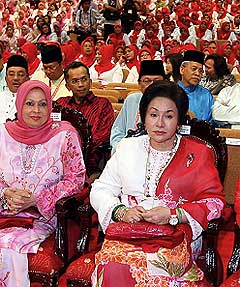
In a statutory declaration (SD) made before Raja Petra left for the UK, the political activist had said he had received information from several people purporting Rosmah (left in photo) as having been present at the place when Altantuya was murdered.
“In that SD of mine, I recounted how there were these people who had informed (me) of these things.
"Let those people come and tell their story. The authorities should investigate and call these people. That's what I said in the SD.
“I myself did not raise any accusations. I did not say I know that the wife of the then-deputy prime minister (Najib) was at the scene of the incident. I did not say that. I did not make the accusation.
"What I said was there were people who told me this, but it depends on the authorities to investigate this further and for those people to come forward.
“I mentioned the names of these people. I mentioned them during the interrogation by the police,” he said.
Raja Petra had previously blogged that he was introduced to Lt Kol Azmi Zainal Abidin - who he described as being the "number two in the special branch of the military intelligence" - who was the source of the accusation against Rosmah.
The people Raja Petra said introduced him to Azmi, furthermore, were Nik Azmi Nik Daud and John Pang, both of whom had worked for Umno stalwart Tengku Razaleigh Hamzah, and blogger Din Merican who was once close to Anwar.
In the interview with Ashraf, Raja Petra said he does not accept any longer the storyline pushed by the trio.
“I don't believe the story anymore. Because I feel, maybe it's impossible. How can the wife of the prime minister have been at that place (where Altantuya killed), as that place is in the middle of the forest.
"I thought, 'would she climb to such a high ground, enter the forest in the middle of the night, midnight? I thought that must be impossible.
According to the TV3 report, Raja Petra said the aim of the three people concerned was to ensure that Najib did not replace Abdullah Ahmad Badawi as prime minister when the latter steps down.
Raja Petra said he had asked Nik Azmi why he was so insistent that he (Raja Petra) make the SD accusing Rosmah of being involved in the case.
“What do you hope to achieve? He (Nik Azmi) said Pak Lah will step down. If we don't block Najib, Najib will be prime minister to succeed Pak Lah.”
Raja Petra said further he then asked Din Merican to get Anwar's approval for the SD.
“Din Merican then contacted me again and he said he had spoken to Anwar and Anwar has given the green light. He said okay, this person (Azmi) is no problem. What he says, we can believe.
"Anwar knows him well and he often meets him, this Lt Kol (Azmi). And he has told Anwar a lot about this issue.
“He (Anwar) said proceed. So I proceeded,” said Raja Petra, who added he was promised that all the individuals involved would be witnesses if he were charged in court.
In an exclusive interview with TV3 group editor Ashraf Abdullah and aired on several major television stations tonight, the Malaysia Today webmaster also turned the tables on Opposition leader Anwar Ibrahim - with whom he has long been associated - by claiming people close to Anwar were behind the accusations against Najib to prevent him from succeeding Abdullah Ahmad Badawi as prime minster.
“I have never accused the prime minister or his wife as being involved in the Altantuya Shaariibuu murder case,” Raja Petra was recorded as telling Ashraf in Perth, Australia.
In a statutory declaration (SD) made before Raja Petra left for the UK, the political activist had said he had received information from several people purporting Rosmah (left in photo) as having been present at the place when Altantuya was murdered.
“In that SD of mine, I recounted how there were these people who had informed (me) of these things.
"Let those people come and tell their story. The authorities should investigate and call these people. That's what I said in the SD.
“I myself did not raise any accusations. I did not say I know that the wife of the then-deputy prime minister (Najib) was at the scene of the incident. I did not say that. I did not make the accusation.
"What I said was there were people who told me this, but it depends on the authorities to investigate this further and for those people to come forward.
“I mentioned the names of these people. I mentioned them during the interrogation by the police,” he said.
Raja Petra had previously blogged that he was introduced to Lt Kol Azmi Zainal Abidin - who he described as being the "number two in the special branch of the military intelligence" - who was the source of the accusation against Rosmah.
The people Raja Petra said introduced him to Azmi, furthermore, were Nik Azmi Nik Daud and John Pang, both of whom had worked for Umno stalwart Tengku Razaleigh Hamzah, and blogger Din Merican who was once close to Anwar.
In the interview with Ashraf, Raja Petra said he does not accept any longer the storyline pushed by the trio.
“I don't believe the story anymore. Because I feel, maybe it's impossible. How can the wife of the prime minister have been at that place (where Altantuya killed), as that place is in the middle of the forest.
"I thought, 'would she climb to such a high ground, enter the forest in the middle of the night, midnight? I thought that must be impossible.
According to the TV3 report, Raja Petra said the aim of the three people concerned was to ensure that Najib did not replace Abdullah Ahmad Badawi as prime minister when the latter steps down.
Raja Petra said he had asked Nik Azmi why he was so insistent that he (Raja Petra) make the SD accusing Rosmah of being involved in the case.
“What do you hope to achieve? He (Nik Azmi) said Pak Lah will step down. If we don't block Najib, Najib will be prime minister to succeed Pak Lah.”
Raja Petra said further he then asked Din Merican to get Anwar's approval for the SD.
“Din Merican then contacted me again and he said he had spoken to Anwar and Anwar has given the green light. He said okay, this person (Azmi) is no problem. What he says, we can believe.
"Anwar knows him well and he often meets him, this Lt Kol (Azmi). And he has told Anwar a lot about this issue.
“He (Anwar) said proceed. So I proceeded,” said Raja Petra, who added he was promised that all the individuals involved would be witnesses if he were charged in court.
Thursday, April 7, 2011
Submarine deal: Deputy minister ‘lied’
A French news portal reveals that it was the Malaysian government and not Amaris, which paid Perimekar 114 million euros in commission.
KUALA LUMPUR: In the latest twist to the submarines deal, a French portal reveals that it was the Malaysian government which paid 114 million euros (RM493.59 million at current value) to Perimekar Sdn Bhd, of which Abdul Razak Baginda’s wife was the majority shareholder.
Quoting sources cited by the plaintiffs in an ongoing legal suit, Rue89 said that it was not the French company Amaris which paid the commission.
This contradicts the stand taken by the Malaysian government. Deputy Defence Minister Zainal Abidin Zin had said in Parliament in 2006 that the commission was not paid by the government.
Zainal Abidin was reported by the local media as saying that the French company paid the commission for a coordination and support services project.
“We did not pay commission to anyone as claimed by Lim (Kit Siang), and the commission was paid voluntarily by France,” said Zainal Abidin, as quoted by the Star on Dec 7, 2006.
“We cannot stop them if they want to give a commission. All the expenditure by the ministry had been tabled in Parliament and audited,” he had said.
The Malaysian Defence Ministry repeated this in a statement on April 2007, as reported by the New Straits Times, that the government did not pay any commission to Perimekar for the purchase of the submarines.
The ministry added that the local company was appointed only to provide the support services and co-ordination as it was a more effective method.
The ministry paid one billion euros to Amaris for the two Scorpene and one Agosta submarines, for which Perimekar received the 11% commission from the French contractor.
However, the Rue89 report claimed that the Malaysian government paid the sum, “with the sole purpose of circumventing the OECD Conventionon (on combating bribery of foreign public officials in International Business Transactions).”
The purchase of the submarines, which also implicated Prime Minister Najib Tun Razak, who was the then defence minister, had been enveloped in sorts of allegations.
The brutal murder of Mongolian national Altantuya Shaariibuu in Malaysia was also linked to the matter, after Abdul Razak, a close aide of Najib, was charged with abetting the murder. He was later acquitted.
It was speculated that Altantuya, an interpreter who acted as intermediary for the contract, was killed for having loudly demanded her share of the commission. Both Najib and the authorities denied this.
Below is the English translation of the Rue89 report, originally titled “Sous-marins malaisiens : la piste des rétrocommissions se précise”:
Further legal action is due to be initiated in the next few days, with Suaram, a Malaysian NGO dedicated to the fight against corruption and member of the International Federation for Human Rights (FIDH), applying to join proceedings as a civil party, which already applied for a judicial review in November 2009.
Suaram would thereby have access to the details of the investigation, which is also a way to force the prosecution service to contact an examining magistrate, the last step before a trial that could last for years.
As was the case for contracts won by the DCN for submarines to Pakistan and frigates to Taiwan, there are increasing suspicions of retrocommissions to French political parties. This case concerns the sale of two Scorpène submarines and an Agosta submarine to the Malaysian government. A contract worth approximately one billion euros, that was signed in 2002 with the Malaysian DCNS (former DCN, Department of Naval Construction) and Thalès.
Model’s body blown up with explosives
Sex, murder, bribery, and suspicions (of) retrocommissions: the cocktail is explosive. It all started with the 2006 murder of Altantuya Shaaribu, a young model, interpreter and also an intermediary in this contract. Her body was found in the Malaysian jungle after being blown apart with explosives.
The young woman appears to have been assassinated for having loudly demanded her share of the commission in an arms deal, in which the other parties involved were her lover, Abdul Razak Baginda, a friend and adviser of the other person involved, Najib Tun Razak, then Malaysia’s minister of defence and now the country’s prime minister.
However, this shady affair hides another, which the French courts took note of. In December 2009, Suaram filed an initial suit against X at the Paris court for “active and passive corruption, trading of favours and abuse of corporate assets”.
The state prosecutor Jean-Claude Marin then opened a preliminary investigation.
At the time, it was suspected that a bribe of 114 million euros had been paid by the company Armaris (a subsidiary of DCNI and Thalès) to Najib and his entourage, through the company Perimekar.
This company, which was officially established to “coordinate” the sale of the three submarines, had Abdul Razak Baginda’s wife as its majority shareholder.
France in violation because of the OECD Convention
However, in the suit filed in December 2009, the plaintiffs argued, that in light of the way the company operated,
…“there is no doubt that this legal entity (Perimekar) was created with a single goal: to organise the payment of commission and distribute the amount amongst the different beneficiaries – Malaysian officials and/or Malaysian or foreign intermediaries.”
However, this contract was signed after the OECD Convention came into force in France in 2000, which punishes corruption of foreign public officials with 10 years imprisonment and a 150,000 euro fine. Following this complaint, a preliminary investigation was conducted by the prosecution: the hearings were made and searches were made at the premises of DCNS and Thalès.
Revealed in September 2008, the note books of Gérard-Philippe Menayas, former chief financial officer of the DCN, who was indicted in the Karachi Case, also confirmed the suspicion of hidden commissions. In his memorandum (PDF), Menayas mentioned the Malaysian submarine contract as follows:
“Since the entry into force of the OECD Convention regarding the fight against corruption in September 2000, only two contracts have been signed; the first with India, and the second with Malaysia in 2002. These two contracts are the result of commercial actions undertaken prior to the OECD Convention. Furthermore, they are both suspected of non-compliance with this Convention. I have evidence to support this.”
At the time of the contract’s signature, Alain Richard was the minister of defence, in Lionel Jospin’s government (Socialist Party).
Three commissions instead of one
With the forthcoming indictment, and the revival of this case, new items had been contributed to the case by the plaintiffs.
First, according to sources cited by the plaintiffs, it was not the company Armaris that paid 114 million euros to Perimekar, but rather the Malaysian government, “with the sole purpose of circumventing the OECD Convention”.
This is a true revelation, while the Malaysian (deputy) minister of defence ended up “confessing” to the payments made by foreign companies to Perimekar.
Where did this money go? Were there retrocommissions to French politicians?
Secondly, there appeared to be not one, but three commissions. In addition to that of 114 million euros, there are two further instalments:
• one paid by the DCNI to the commercial networks of Thalès, for over 30 million euros, corresponding to “commercial fees relating to the negotiation and execution of the contract”;
• the other for 2.5 million euros.
However, according to Gerard Philippe Menayas:
“Until the OECD Convention against corruption came into force in France, no contract for the sale of defence equipment to an emerging country could take place without the payment of commissions to policy-makers (euphemistically called ‘commercial fees for exports’ or ‘FCE’).”
The second commission was paid by Thalès to a recipient, who remains unknown, in order to convince the Malaysian government of the need to conduct additional work.
Finally, according to the complaint filed by the firm Bourdon, Suaram’s lawyer, the company Gifen, which was established by Jean-Marie Boivin in Malta, intervened in the negotiations “so as to facilitate the money transfers in this case”, and particularly finance the trips of Baginda and Altantuya.
The “catch” is that Jean-Marie Boivin is also cited in the Karachi case… for his role in the system for supplying slush funds to political parties. (Source FMT)
KUALA LUMPUR: In the latest twist to the submarines deal, a French portal reveals that it was the Malaysian government which paid 114 million euros (RM493.59 million at current value) to Perimekar Sdn Bhd, of which Abdul Razak Baginda’s wife was the majority shareholder.
Quoting sources cited by the plaintiffs in an ongoing legal suit, Rue89 said that it was not the French company Amaris which paid the commission.
This contradicts the stand taken by the Malaysian government. Deputy Defence Minister Zainal Abidin Zin had said in Parliament in 2006 that the commission was not paid by the government.
Zainal Abidin was reported by the local media as saying that the French company paid the commission for a coordination and support services project.
“We did not pay commission to anyone as claimed by Lim (Kit Siang), and the commission was paid voluntarily by France,” said Zainal Abidin, as quoted by the Star on Dec 7, 2006.
“We cannot stop them if they want to give a commission. All the expenditure by the ministry had been tabled in Parliament and audited,” he had said.
The Malaysian Defence Ministry repeated this in a statement on April 2007, as reported by the New Straits Times, that the government did not pay any commission to Perimekar for the purchase of the submarines.
The ministry added that the local company was appointed only to provide the support services and co-ordination as it was a more effective method.
The ministry paid one billion euros to Amaris for the two Scorpene and one Agosta submarines, for which Perimekar received the 11% commission from the French contractor.
However, the Rue89 report claimed that the Malaysian government paid the sum, “with the sole purpose of circumventing the OECD Conventionon (on combating bribery of foreign public officials in International Business Transactions).”
The purchase of the submarines, which also implicated Prime Minister Najib Tun Razak, who was the then defence minister, had been enveloped in sorts of allegations.
The brutal murder of Mongolian national Altantuya Shaariibuu in Malaysia was also linked to the matter, after Abdul Razak, a close aide of Najib, was charged with abetting the murder. He was later acquitted.
It was speculated that Altantuya, an interpreter who acted as intermediary for the contract, was killed for having loudly demanded her share of the commission. Both Najib and the authorities denied this.
Below is the English translation of the Rue89 report, originally titled “Sous-marins malaisiens : la piste des rétrocommissions se précise”:
Further legal action is due to be initiated in the next few days, with Suaram, a Malaysian NGO dedicated to the fight against corruption and member of the International Federation for Human Rights (FIDH), applying to join proceedings as a civil party, which already applied for a judicial review in November 2009.
Suaram would thereby have access to the details of the investigation, which is also a way to force the prosecution service to contact an examining magistrate, the last step before a trial that could last for years.
As was the case for contracts won by the DCN for submarines to Pakistan and frigates to Taiwan, there are increasing suspicions of retrocommissions to French political parties. This case concerns the sale of two Scorpène submarines and an Agosta submarine to the Malaysian government. A contract worth approximately one billion euros, that was signed in 2002 with the Malaysian DCNS (former DCN, Department of Naval Construction) and Thalès.
Model’s body blown up with explosives
Sex, murder, bribery, and suspicions (of) retrocommissions: the cocktail is explosive. It all started with the 2006 murder of Altantuya Shaaribu, a young model, interpreter and also an intermediary in this contract. Her body was found in the Malaysian jungle after being blown apart with explosives.
The young woman appears to have been assassinated for having loudly demanded her share of the commission in an arms deal, in which the other parties involved were her lover, Abdul Razak Baginda, a friend and adviser of the other person involved, Najib Tun Razak, then Malaysia’s minister of defence and now the country’s prime minister.
However, this shady affair hides another, which the French courts took note of. In December 2009, Suaram filed an initial suit against X at the Paris court for “active and passive corruption, trading of favours and abuse of corporate assets”.
The state prosecutor Jean-Claude Marin then opened a preliminary investigation.
At the time, it was suspected that a bribe of 114 million euros had been paid by the company Armaris (a subsidiary of DCNI and Thalès) to Najib and his entourage, through the company Perimekar.
This company, which was officially established to “coordinate” the sale of the three submarines, had Abdul Razak Baginda’s wife as its majority shareholder.
France in violation because of the OECD Convention
However, in the suit filed in December 2009, the plaintiffs argued, that in light of the way the company operated,
…“there is no doubt that this legal entity (Perimekar) was created with a single goal: to organise the payment of commission and distribute the amount amongst the different beneficiaries – Malaysian officials and/or Malaysian or foreign intermediaries.”
However, this contract was signed after the OECD Convention came into force in France in 2000, which punishes corruption of foreign public officials with 10 years imprisonment and a 150,000 euro fine. Following this complaint, a preliminary investigation was conducted by the prosecution: the hearings were made and searches were made at the premises of DCNS and Thalès.
Revealed in September 2008, the note books of Gérard-Philippe Menayas, former chief financial officer of the DCN, who was indicted in the Karachi Case, also confirmed the suspicion of hidden commissions. In his memorandum (PDF), Menayas mentioned the Malaysian submarine contract as follows:
“Since the entry into force of the OECD Convention regarding the fight against corruption in September 2000, only two contracts have been signed; the first with India, and the second with Malaysia in 2002. These two contracts are the result of commercial actions undertaken prior to the OECD Convention. Furthermore, they are both suspected of non-compliance with this Convention. I have evidence to support this.”
At the time of the contract’s signature, Alain Richard was the minister of defence, in Lionel Jospin’s government (Socialist Party).
Three commissions instead of one
With the forthcoming indictment, and the revival of this case, new items had been contributed to the case by the plaintiffs.
First, according to sources cited by the plaintiffs, it was not the company Armaris that paid 114 million euros to Perimekar, but rather the Malaysian government, “with the sole purpose of circumventing the OECD Convention”.
This is a true revelation, while the Malaysian (deputy) minister of defence ended up “confessing” to the payments made by foreign companies to Perimekar.
Where did this money go? Were there retrocommissions to French politicians?
Secondly, there appeared to be not one, but three commissions. In addition to that of 114 million euros, there are two further instalments:
• one paid by the DCNI to the commercial networks of Thalès, for over 30 million euros, corresponding to “commercial fees relating to the negotiation and execution of the contract”;
• the other for 2.5 million euros.
However, according to Gerard Philippe Menayas:
“Until the OECD Convention against corruption came into force in France, no contract for the sale of defence equipment to an emerging country could take place without the payment of commissions to policy-makers (euphemistically called ‘commercial fees for exports’ or ‘FCE’).”
The second commission was paid by Thalès to a recipient, who remains unknown, in order to convince the Malaysian government of the need to conduct additional work.
Finally, according to the complaint filed by the firm Bourdon, Suaram’s lawyer, the company Gifen, which was established by Jean-Marie Boivin in Malta, intervened in the negotiations “so as to facilitate the money transfers in this case”, and particularly finance the trips of Baginda and Altantuya.
The “catch” is that Jean-Marie Boivin is also cited in the Karachi case… for his role in the system for supplying slush funds to political parties. (Source FMT)
Subscribe to:
Posts (Atom)